 Despite having fathered Ada Lovelace, the world’s first computer programmer, Lord Byron
(January 22, 1788–April 19, 1824) is best remembered for his poetry,
countless collections of which have been published in the centuries
since he put ink to paper. But arguably the best such volume is a rare
vintage gem published by Doubleday — which also commissioned Salvador Dalí’s illustrations for the essays of Montaigne and Edward Gorey’s paperback covers for literary classics — in 1972. The lavish thousand-page tome Asimov’s Annotated Don Juan (public library) presents Byron’s Don Juan
— one of the great epic poems in the English language, launching an
audacious and timeless attack on greed, complacency, and hypocrisy —
with annotations by beloved writer Isaac Asimov, a man of strong opinions and a large heart, and breathlessly gorgeous pen-and-ink illustrations by none other than Milton Glaser, creator of the iconic I♥NY logo and celebrated as the greatest graphic designer of our time.
Despite having fathered Ada Lovelace, the world’s first computer programmer, Lord Byron
(January 22, 1788–April 19, 1824) is best remembered for his poetry,
countless collections of which have been published in the centuries
since he put ink to paper. But arguably the best such volume is a rare
vintage gem published by Doubleday — which also commissioned Salvador Dalí’s illustrations for the essays of Montaigne and Edward Gorey’s paperback covers for literary classics — in 1972. The lavish thousand-page tome Asimov’s Annotated Don Juan (public library) presents Byron’s Don Juan
— one of the great epic poems in the English language, launching an
audacious and timeless attack on greed, complacency, and hypocrisy —
with annotations by beloved writer Isaac Asimov, a man of strong opinions and a large heart, and breathlessly gorgeous pen-and-ink illustrations by none other than Milton Glaser, creator of the iconic I♥NY logo and celebrated as the greatest graphic designer of our time.What makes the pairing especially poetic is that, besides their match of cultural stature, Asimov and Glaser have in common a certain sensibility, a shared faith in the human spirit — Asimov with his religion of humanism and Glaser with his belief in the kindness of the universe.

To be sure, Asimov takes no prisoners with his annotations — or, rather, plays along with Byron — beginning with the opening verse, which reads:
FRAGMENTBeneath it, Asimov winks:
I would to heaven that I were so much clay,
As I am blood, bone, marrow, passion, feeling—
Because at least the past were passed away—
And for the future—(but I write this reeling,
Having got drunk exceedingly today,
So that I seem to stand upon the ceiling)
I say—the future is a serious matter—
And so—for God’s sake—hock and soda water!
This isolated stanza has nothing to do with the poem, but it epitomizes Byron’s utter lack of reverence for anything—even himself—and therefore sets the tone of what follows, even if it is divorced from the content.
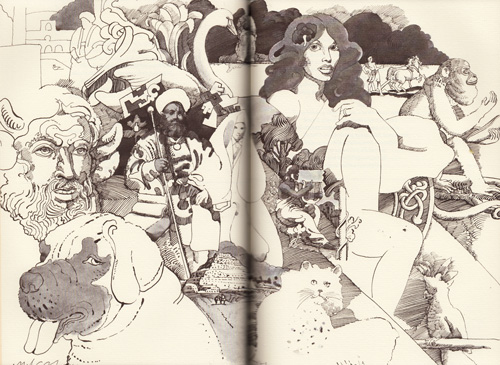
After Byron’s third stanza, which begins with “You, Bob! are rather insolent, you know” and ends “… because you soar too high, Bob, / And fall, for lack of moisture quite a dry, Bob!,” Asimov, who wears the many hats of historian, etymologist, lexicographer, literary critic, and cultural commentator, adds an entertaining and educational clarifier:
“A dry Bob” seems to have been then-current slang for intercourse without ejaculation (“lack of moisture”). The use of the phrase shocked and (of course) titillated the public and was a particularly effective way of indicating that Southey went through the motions of writing poetry without producing anything poetic.

Though most of Asimov’s annotations offer biographical and historical context, they are by no means dry or bland. He imbues his commentary with his characteristic snark: After another Byron verse that reads “And recollect a poet nothing loses / in giving to his brethren their full meed / of merits, and complaint of present days / Is not the certain path to future praise,” Asimov snidely remarks:
It is obvious that Byron emphatically does not follow his own advice, but then few people do.Indeed, Asimov seems entranced by Byron’s contradictions. In another note, he writes:
There was a great deal of cousin-marriage in Byron’s family. But that was not all. Perhaps the most scandalous item in the Byronic array of scandal was the fact that Byron seems to have made his half-sister, Augusta, his mistress, and to have had a daughter by her. He was fascinated by his own action in this respect and dealt with incest over and over in his writing.

Asimov’s own witty and spirited irreverence comes through once again in a comment on Byron’s usage of “wh—” and “G—d” in the fourth canto, wherein Asimov adds to literary history’s finest meditations on censorship:
Like “damn,” “whore” could not be spelled out, though what sense of purity is served by a missing “o” is known only to the Devil and to censors.
[…]
“God,” like “whore,” sometimes requires a missing “o” to be acceptable to the censor. Surely only a censor’s mind could find such neatly equal embarrassment in these two words.

Asimov weaves his own reservations about religion into the annotations, remarking in one about Byron’s line “‘But heaven,’ as Cassio says, ‘is above all—'” in canto nine:
The phrase “heaven is above all” is a kind of last resort of puzzled mankind. If problems are insoluble, leave them then to God, to whom nothing (by definition) is insoluble. Thus, in Shakespeare’s Othello, when Cassio is tempted into drinking by the villainous Iago, the former quickly finds himself befuddled by alcohol and must find refuge in “Well; God’s above all…”

Above all, however, Asimov seems to peer straight into Byron’s soul, discerning his motives and intentions with equal parts clarity and compassion. In the twelfth canto, where Byron writes “I thought, at setting off, about two dozen / Cantos would do; but at Apollo’s pleading, / If that my Pegasus should not be founder’d, / I think to canter gently through a hundred,” Asimov remarks:
Byron may well have intended to keep writing Don Juan all his life as a perfect vehicle for satirizing the age. But, alas, he was approaching the end.

In his final footnote, Asimov revisits the subject of Don Juan’s intended fate:
Byron always maintained he had no plan for Don Juan, but simply improvised as he went along, taking all the world as his target. And, indeed, as we go from canto to canto, the plot grows thinner, the digressions longer, the satire deeper, so that it is not beyond the bounds of possibility that no matter how long he had lived and how long written, Byron would never have finished Don Juan nor progressed enormously with the plot, even though the number of cantos had reached the century mark. At one time he said he would send Juan to every nation in turn, satirizing each in its own fashion, and have him end an extreme radical like Cloots in the Reign of Terror, or else to end by sending him either to Hell or to an unhappy marriage, whichever was worse.
And yet — I wonder if Byron might not have relented. Might he not have had Don Juan visit Hell, but have had him saved from damnation by the intercession of the shade of Haidée, surely to be found in Heaven? Might he not, then, in the end, have married Leila, the little girl he had saved at Izmail, and settled down to the blameless life of husband, father, and country squire?

Though Asimov’s Annotated Don Juan is, sadly, long out of print, I was fortunate enough to find a surviving copy of this out-of-print treasure at Heather O’Donnell’s wonderful Honey & Wax, which is a gift to bibliophiles everywhere and a heartening game-changer for the world of rare books. Copies can also be found elsewhere online as well as at some better-stocked public libraries, and are well worth the splurge or the trip.
Complement this treat with other rare artistic editions of literary classics, including Matisse’s 1935 etchings for Ulysses, Picasso’s drawings for a naughty ancient Greek comedy, William Blake’s paintings for Dante’s Divine Comedy, and Salvador Dalí’s prolific illustrations for Don Quixote in 1946, the essays of Montaigne in 1947, Alice in Wonderland in 1969, and Romeo & Juliet in 1975.
